Achilles Tendinopathy: Why Your Achilles Hurts and How to Recover
You get out of bed, take your first few steps and immediately feel that familiar stiffness at the back of your ankle.
Maybe it eases once you start moving. Maybe it returns after running, walking or spending time on your feet.
If this sounds familiar, you could be experiencing Achilles tendinopathy, a common cause of pain and stiffness around the Achilles tendon.
While resting may temporarily ease discomfort, complete rest is rarely the whole solution.
Understanding how the Achilles tendon responds to load is essential to managing symptoms and returning to activity.
What is Achilles tendinopathy?
The Achilles tendon is the strong tendon connecting your calf muscles to your heel bone.
It plays a major role in walking, running, jumping and pushing off the ground.
Achilles tendinopathy develops when the tendon becomes painful and less able to tolerate the demands placed on it.
You may also come across the term Achilles tendonitis when searching for this condition. Although often used interchangeably, Achilles tendinopathy is generally the more appropriate term for persistent tendon-related pain, as the condition is not always primarily inflammatory.
What are the symptoms of Achilles tendinopathy?
Common symptoms include:
Pain or stiffness around the Achilles tendon
Morning stiffness, particularly during your first few steps
Pain when beginning a run or other activity
Discomfort after running, jumping or prolonged walking
Tenderness or thickening around the tendon
Reduced ability to tolerate your usual exercise
Symptoms can develop gradually and may fluctuate depending on your activity levels.
Why does your Achilles tendon hurt in the morning?
Morning stiffness is a common feature of Achilles tendinopathy.
After a period of rest, the tendon may feel uncomfortable when you first begin placing load through it.
Some people notice that symptoms ease as they move around, only to return after more demanding activity.
Although this pattern can occur with Achilles tendinopathy, morning pain alone doesn’t confirm a diagnosis.
A physiotherapy assessment can help determine the source of your symptoms.
What causes Achilles tendinopathy?
The Achilles tendon is designed to tolerate substantial loads.
Problems can develop when the demands placed on the tendon exceed its current capacity.
Common contributing factors may include:
Sudden increases in running distance
Increasing your weekly mileage too quickly can place additional demands on the tendon.
More hill training
Running uphill changes the demands on the calf muscles and Achilles tendon.
Changes in training intensity
Introducing faster running, jumping or other demanding activities can increase tendon loading.
Returning to sport after a break
Your tendon may need time to readapt to activities you previously tolerated comfortably.
Changes in overall activity
Even increases in walking or time spent on your feet may contribute to symptoms in some people.
The solution isn’t necessarily to avoid loading the tendon altogether.
It’s to find an appropriate level of activity and gradually build from there.
Should you stop running with Achilles tendon pain?
Not automatically.
Depending on your symptoms and the nature of the condition, you may be able to continue some running while temporarily reducing the demands placed on your Achilles tendon.
This might involve adjusting your running distance, frequency, speed or hill training.
However, the appropriate amount of activity varies between individuals.
If you experience sudden severe pain, a popping sensation or an inability to push off normally, seek urgent medical assessment to exclude a tendon rupture.
How can physiotherapy help Achilles tendinopathy?
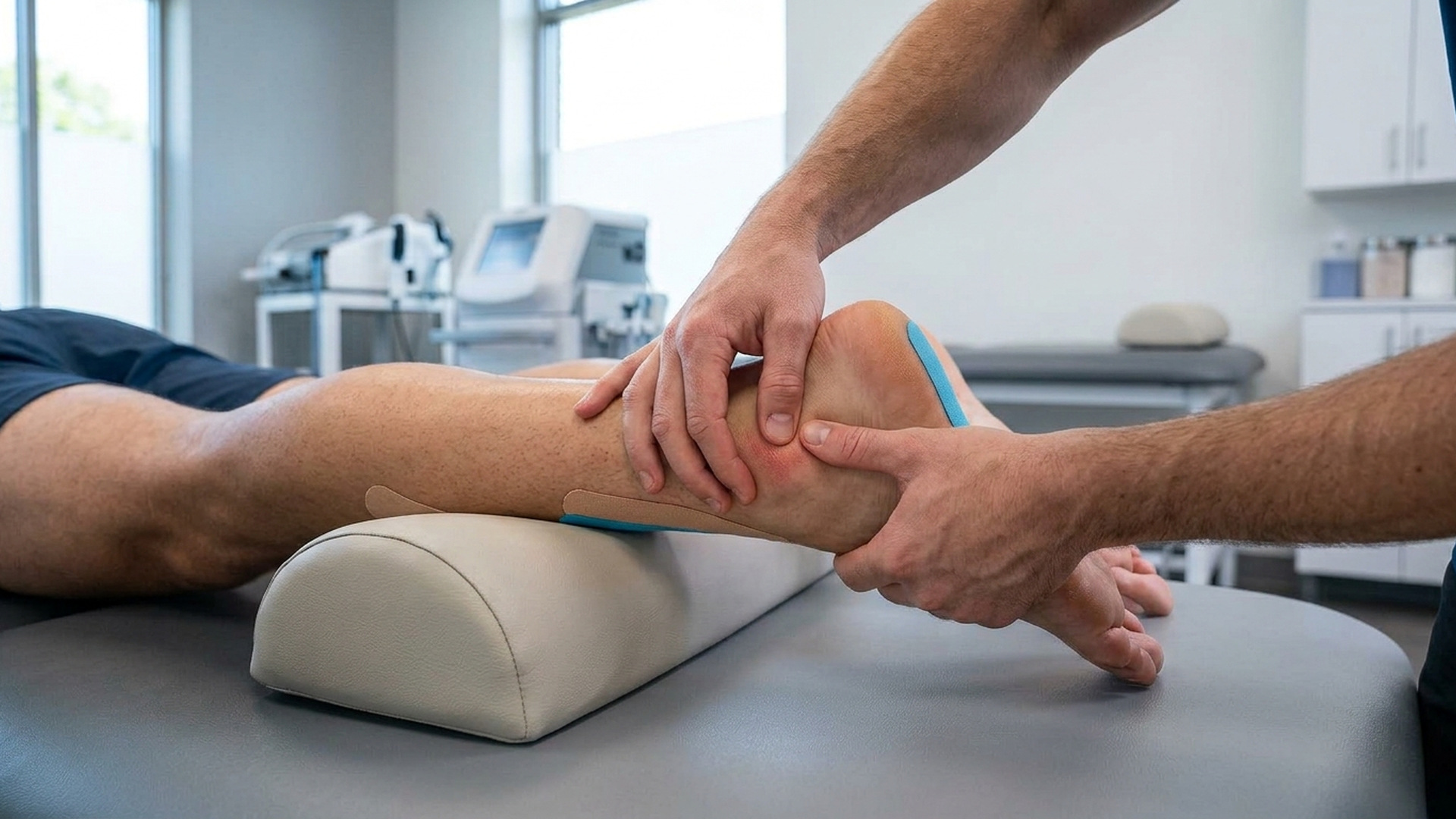
At Gray Physiotherapy in Constantia, we assess the factors contributing to your Achilles pain and how well your tendon currently tolerates load.
Your assessment may include:
Ankle and foot mobility
Calf strength and endurance
Tendon loading capacity
Running and training history
Recent changes in exercise
Previous injuries
Running biomechanics where appropriate
These findings help guide an individualised rehabilitation programme.
What exercises help Achilles tendinopathy?
Progressive tendon-loading exercise is central to rehabilitation for many cases of Achilles tendinopathy.
Depending on your assessment and symptoms, rehabilitation may involve:
Controlled calf strengthening
Beginning with exercises that help your calf muscles and Achilles tendon tolerate manageable loads.
Progressive resistance training
Gradually increasing the demands placed on the tendon as its capacity improves.
Functional strengthening
Preparing the muscles and tendon for the demands of everyday movement and exercise.
Return-to-sport exercises
Where appropriate, progressing towards faster movements, hopping, jumping and running.
Not every exercise is suitable for every type of Achilles pain. For example, exercises involving deep ankle bending may need modification for certain presentations.
The aim is to improve the tendon’s ability to manage the activities you want to return to, rather than focusing only on temporary symptom relief.
Should you stretch a painful Achilles tendon?
It depends.
Stretching isn’t automatically appropriate for every form of Achilles pain.
Some movements may aggravate sensitive tendon structures, particularly when compression contributes to symptoms.
Your physiotherapist can help determine whether stretching should form part of your rehabilitation programme.
How long does Achilles tendinopathy take to heal?
Tendons can take time to adapt.
Recovery depends on several factors, including:
How long symptoms have been present
The severity of the condition
Your current strength and activity levels
The demands of your chosen sport or exercise
Consistency with an appropriate rehabilitation programme
Rather than focusing only on when the pain disappears, rehabilitation should also address whether your tendon has developed enough capacity to manage future activity.
Frequently asked questions about Achilles tendinopathy
Does Achilles pain mean my tendon is going to rupture?
No. Achilles tendinopathy and Achilles tendon rupture are different conditions. However, sudden severe pain or loss of function requires urgent medical assessment.
Can Achilles tendinopathy improve without complete rest?
Often, yes. Appropriate activity modification and progressive loading are important parts of rehabilitation for many people with Achilles tendinopathy.
Why does my Achilles hurt after running?
Running places repeated loads on the Achilles tendon. Pain after running may indicate that your current training demands exceed the tendon’s capacity.
Can strengthening help Achilles tendon pain?
Progressive strengthening is a key component of Achilles tendinopathy rehabilitation. Exercise selection and loading should be tailored to your symptoms and individual needs.
Find the right load. Build the capacity. Keep moving.
Complete rest doesn’t automatically prepare your Achilles tendon for running, walking or sport.
The goal is to understand your symptoms, manage aggravating activities and progressively rebuild the strength and capacity your tendon needs.
Struggling with Achilles pain or morning stiffness?
Gray Physiotherapy, based at Mediclinic Constantiaberg, offers individualised assessment and rehabilitation to help you manage Achilles tendon pain and return to activity confidently.
Call 021 797 1777 to book your physiotherapy assessment.
Recent Comments